Clinal variation in quantitative traits but not in evolutionary potential along elevational and latitudinal gradients in the widespread Anthyllis vulneraria

Description

Premise: Strong elevational and latitudinal gradients allow the study of genetic
differentiation in response to similar environmental changes. However, it is uncertain
whether the environmental changes along the two types of gradients result in similar
genetically based changes in quantitative traits. Peripheral arctic and alpine
populations are thought to have less evolutionary potential than more central
populations do.
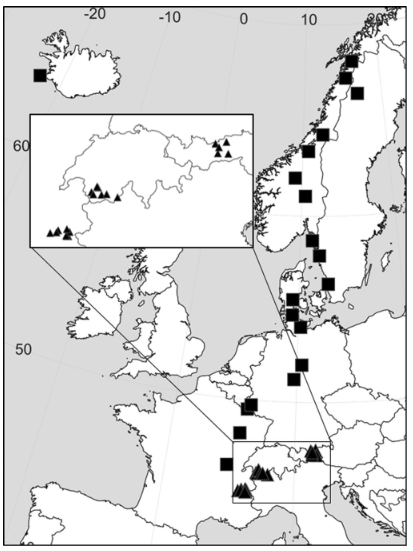
Methods: We studied quantitative traits of the widespread Anthyllis vulneraria in a
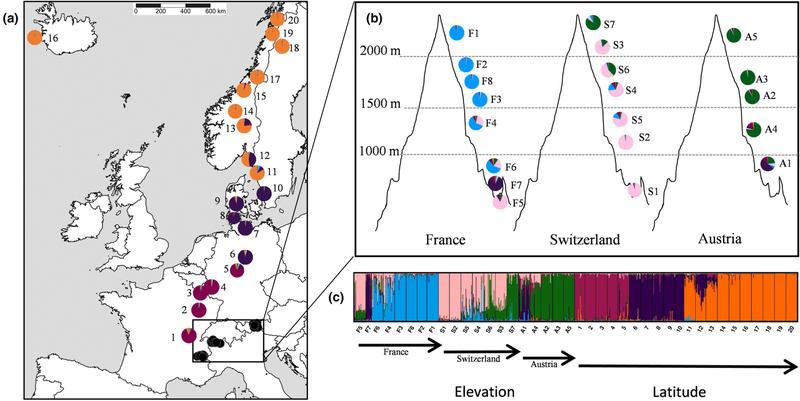
common garden. Plants originated from 20 populations along a 2000‐m elevational
gradient from the lowlands to the elevational limit of the species in the Alps, and from
20 populations along a 2400‐km latitudinal gradient from the center of the
distribution of the species in Central Europe to its northern distributional margin.
Results: Most traits showed similar clinal variations with elevation and latitude of
origin, and the magnitude of all measured traits in relation to mean annual
temperature was similar. Higher QST values than FST values in several traits indicated
diversifying selection, but for others QST was smaller than FST. Genetic diversity of
quantitative traits and neutral molecular markers was not correlated. Plasticity in
response to favorable conditions declined with elevation and less strongly with
latitude of origin, but the evolvability of traits did not.
Conclusions: The clinal variation suggests adaptive differentiation of quantitative
traits along the two gradients. The evolutionary potential of peripheral populations is
not necessarily reduced, but lower plasticity may threaten their survival under rapidly
changing climatic conditions.

Thématique

Science et technologie

Type

Papier

Mots-clés

  • adaptation

  • anthyllis-vulneraria

  • evolutionary-potential

  • genetics

Date de création

23 janvier 2026

Dernière mise à jour

23 janvier 2026

1 jeu de données

Discussions

Il n'y a pas encore de discussion pour cette réutilisation.

4 réutilisations du même créateur